
Azusa Voter Status Walkthrough
For a current Azusa voter, the most direct route is the Los Angeles County Voter Status lookup. It is a personal status tool, not a browseable list of every voter in the city. The search asks for identity and address clues that should match the voter record on file with the Los Angeles County Registrar-Recorder/County Clerk. If the local lookup fails, California also points voters to My Voter Status, the Secretary of State entry point for statewide registration checks.
| Search Field | Entry Type | Required | Format Notes |
|---|---|---|---|
| Last Name | Text | Yes | Alphabet only. |
| Birthdate | Date | Yes | Use mm/dd/yyyy. |
| House Number | Number | Yes | Residence house number, numbers only. |
| Zip Code | Number | Yes | Use the registration ZIP code. |
| Search | Button | No | Help phone listed by the tool: (800) 815-2666, option 2. |
The county form is useful when a voter needs to confirm status, address match, or next election information before a deadline. It does not replace the full voter file request. It also does not show ballot choices. If a status check does not match an Azusa address, contact the county elections office rather than guessing from a partial result.
The LA County status lookup screenshot in the manifest comes from the official county voter status portal.
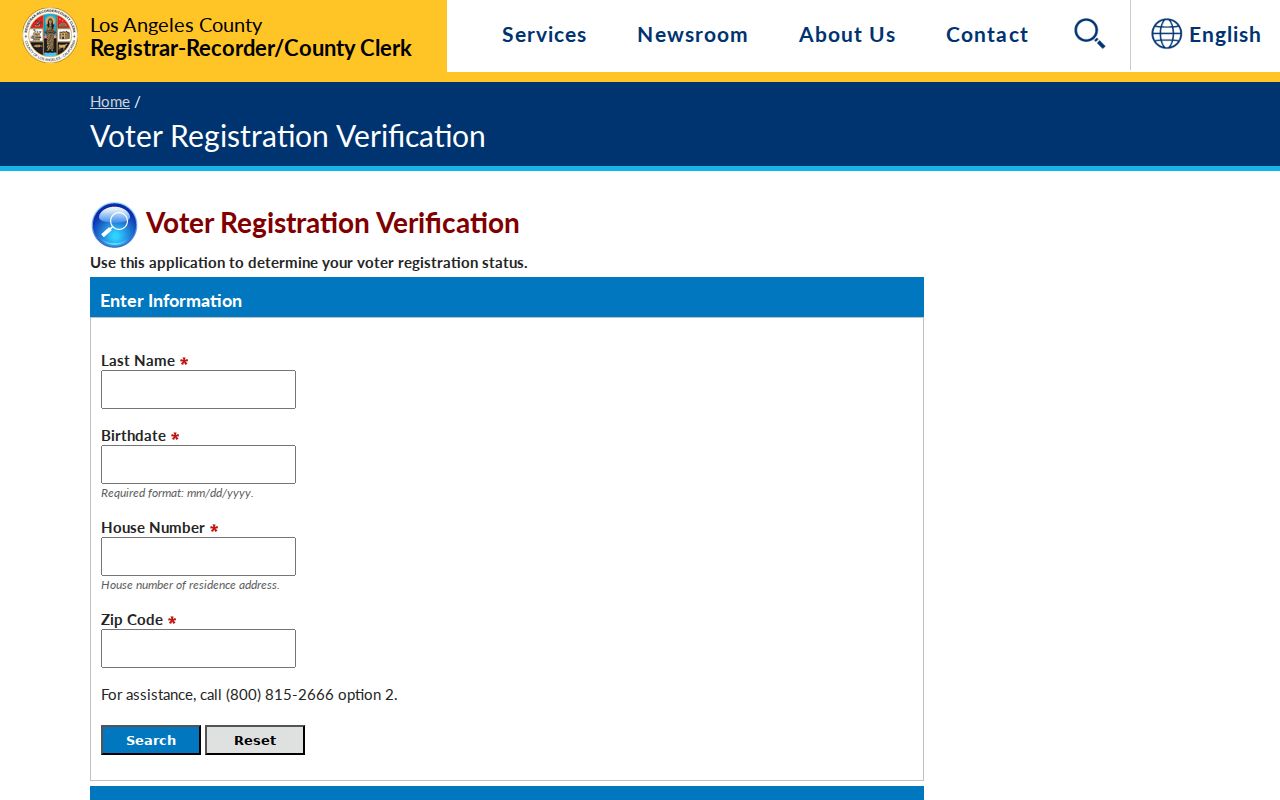
The image reinforces the field-by-field path: last name, birthdate, house number, and ZIP code must all line up before the tool can return a status result.
California Voter Status Checks
California's My Voter Status tool is the statewide counterpart. Research found that the live tool could verify registration, registration address, political party preference, language preference, vote-by-mail or provisional ballot status, polling and vote center information, upcoming elections, and county election office contact details. The research environment could not inspect the statewide tool fields because access was blocked by Incapsula, so the LA County field table is the reliable field inventory for Azusa.
Use the statewide tool when a voter has moved, when the county is uncertain, or when a county page does not return the expected result. Use the county tool when the registration is known to be tied to Los Angeles County. Both tools are status checks for the voter, not open directories.
Lookup boundary. A status tool confirms a voter record for the person who supplies matching identity details. It is not a public name search across Azusa voter rolls.
California Voter Records Inventory
California treats voter data as regulated data. Approved voter file applicants may receive fields that identify the voter, county, districts, voting history, and registration facts, but the file is not the same thing as a public web index. For Azusa, those records sit in the Los Angeles County and California elections systems, with city residents appearing as part of county, district, and precinct data.
| Registration county | Shows the county tied to the voter record, such as Los Angeles County for Azusa residents. |
|---|---|
| Voter ID fields | Unique registration or county voter ID may be included for approved applicants. |
| Name and addresses | Name, residential address, and mailing address may appear unless a confidentiality rule applies. |
| Contact and preference fields | Phone, email, language preference, gender, and party preference may be present to the extent they exist in the record. |
| Status facts | Registration status, date, method, precinct, and district assignments may be included. |
| Voting history | Shows participation facts, such as election date and voting method. It never shows ballot choices. |
A voter file can help with civic, scholarly, journalistic, political, or governmental research when the purpose is approved under state rules. It should not be treated as a broad people-finder. The record set is powerful because it can connect a person to a precinct, district, and participation history, but the law draws a hard line around sensitive data and use.
Confidential Azusa Voter Data
Several California rules narrow what can be released. The Secretary of State voter file materials cite Elections Code sections 2188, 2194, and 18109, Government Code section 7924.000, Title 2 California Code of Regulations sections 19001 through 19013, and Business and Professions Code section 17538.41. Those rules matter more than the general public-records frame because voter data has its own request system and its own limits.
Confidential by law. Driver license number, state ID number, the last four digits of a Social Security number, unique identifiers, and signature or digitized signature images are excluded under Elections Code section 2194(b). Confidential voters under Elections Code sections 2166, 2166.5, 2166.7, and 2166.8 are excluded from public voter data requests.
Pre-registration records for 16- and 17-year-olds are not included. Date of birth appears in regulated voter data, but it is sensitive and not general public information. The California Public Records Act still matters for many local records, and its timing rule is summarized on the Azusa public records page, but voter file access follows the elections application route.
Azusa Voter File Requests
The full California voter file is requested through the Secretary of State, not through a casual web search. The state voter file request page and the application form require the applicant to identify themselves, state the beneficiary, explain the purpose, and describe security controls for the data. Fax and email submission are not accepted.
| Request Step | What California Requires | Azusa Relevance |
|---|---|---|
| Prepare the application | Use the original signed California Voter Registration File Request application. | Ask for the geography needed, such as county, district, or statewide records. |
| Attach ID and purpose details | Include a clear copy of a current driver license or state ID, plus the intended use and security explanation. | Azusa records are not released just because a name is local. |
| Submit by mail or hand delivery | Send it to Secretary of State, 1500 11th Street, 5th Floor, Sacramento, CA 95814. | Local voters are included through the state and county file structure. |
| Pay the fee | Statewide registration data is $15 per thousand records up to $100. Specific voter records are $30 per record up to $100, limited to 10 records per application. | The fee depends on the request type, not on the city alone. |
| Wait for review | Processing is listed as 7 to 14 business days after receipt. | Plan ahead for election, research, or archive timelines. |
The SOS voter file request screenshot in the manifest was captured from the California voter file request instructions.
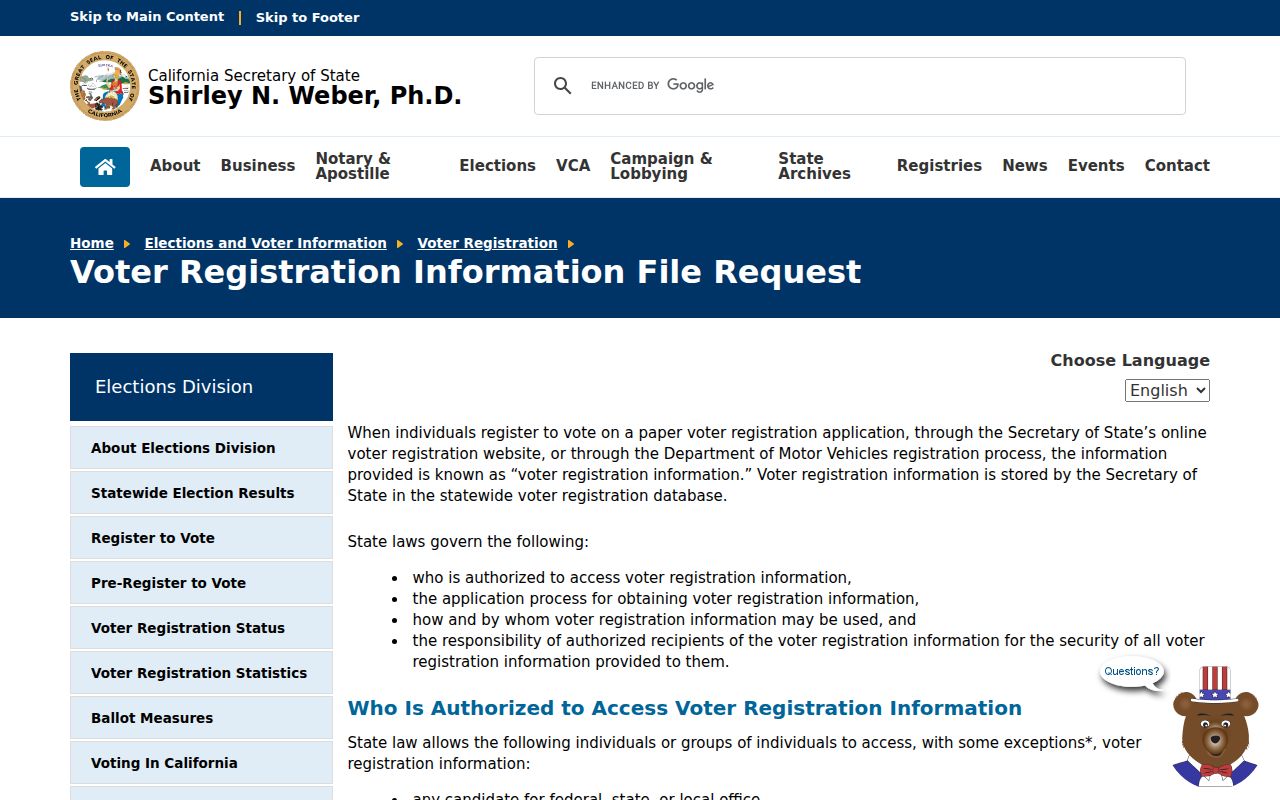
The screenshot belongs with the request process because it shows the official source for fees, delivery rules, and approved-use expectations.
Voter File Delivery Details
Delivery depends on the request type. Statewide, county, and district requests are delivered as encrypted DVDs in tab-delimited text files. Specific voter records are sent by encrypted WinZip email attachment. The application asks whether inactive voters, voting history, and a precinct-to-district file are requested, so the applicant should decide those points before filing.
The form also asks for applicant full name, phone, email, business address, mailing address, beneficiary name and address, organization type, purpose, requested location, shipping information, and a detailed description of intended use. A thin purpose statement can slow the request because the Secretary of State must decide whether the use fits state rules.
- Tab-delimited file
- A plain text data format where each field is separated by a tab, useful for spreadsheets and database tools.
- Inactive voter
- A registration status category that may be requested if the applicant needs more than current active records.
- Participation history
- A record of whether and how a voter participated in an election, not how the person voted.
LA County's Azusa Search
Los Angeles County has a smaller local route for a named search. The Registrar-Recorder/County Clerk states that searching the voter file costs $5 for each name searched. In person, the requester visits the Election Information Section and completes the request form. By mail, the written request must include the requester's name, address, birth date, signature, telephone number, and a self-addressed stamped envelope.
Mail requests go to Registrar-Recorder/County Clerk, Election Information Section, 12400 Imperial Hwy., Room 2013, Norwalk, CA 90650. This is the practical route when the question is narrower than a statewide voter file application. It is still not a public web search, and it should be used for a specific lawful purpose.
Note: The county also runs the personal status portal, but that tool and the $5 file search are separate access channels.
Safe at Home Voter Protection
California Safe at Home is an address confidentiality program run by the Secretary of State. It gives eligible participants a substitute mailing address that California state, county, city agencies, and courts must accept in place of the participant's actual residence address. Eligible groups include people protected under domestic violence, sexual assault, stalking, human trafficking, child abduction, elder or dependent adult abuse, reproductive health care worker, and public-entity employee safety provisions.
The program is free, certification lasts four years, and participants must report address or name changes within seven days. Safe at Home does not erase information already in public records. Participants are told to ask agencies to replace confidential information with the program address when possible.
The Safe at Home screenshot in the manifest comes from the California Secretary of State address confidentiality program page.
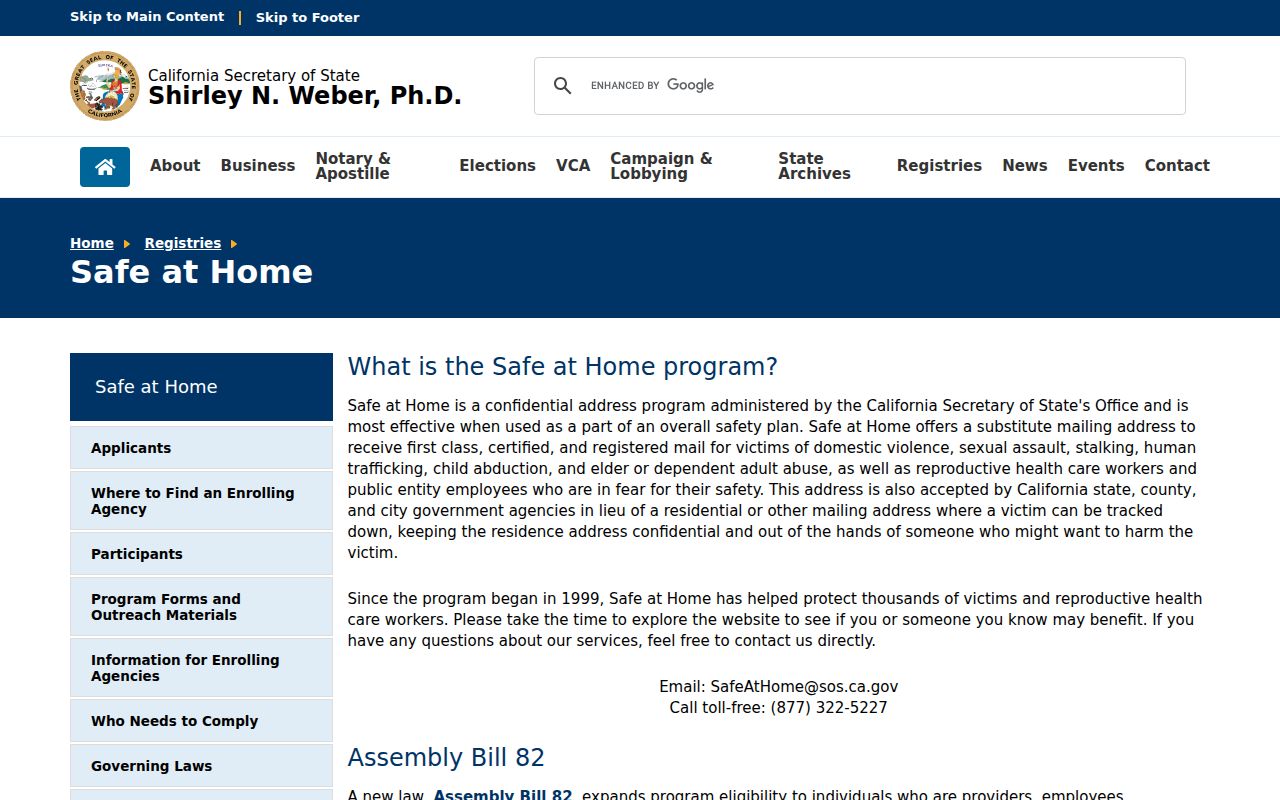
The image is important for voter privacy because protected addresses and confidential voter records are handled outside ordinary voter file release.
Azusa Historical Voter Routes
Older voter research is not the same as current voter registration access. California State Archives family-history resources include Great Registers and selected local government record groups, with county records spanning 1850 to 1987 in the research inventory. For Azusa names, historical voter registers may work best alongside city directories, newspaper notices, probate, and property records because people moved, precincts changed, and early record groups are incomplete.
Use the California State Archives family-history resources for Great Registers and archival county material. Then check Los Angeles Public Library city-directory holdings, LA County Library Californiana, FamilySearch, and the official Azusa Herald archive when a name needs local context. The historical path is slower, but it can place a person in a time, precinct, neighborhood, or civic record without relying on modern regulated voter data.
Azusa Voter Use Limits
California allows voter file data for approved election, scholarly, journalistic, political, or governmental purposes as determined under the voter file rules. It bars unapproved purposes, unauthorized sharing or transfer, harassment of a voter or household, commercial advertising or marketing, and leaving the data unsecured or publicly available. Misuse can be a misdemeanor under Elections Code section 18109.
That penalty rule is why Azusa voter records should be handled as controlled data, not casual directory material. Keep a copy only as long as the approved use requires it. Do not post the file online. Do not pass it to someone who was not approved to receive it. When the goal is simple self-checking, use the county or state status lookup instead of requesting data that carries storage and use duties.